


The Data Transparency Pavilion brought together the PHUSE Community to examine how clinical trial data transparency is being delivered responsibly and at scale. Through keynotes and expert discussions, the Pavilion shared practical frameworks, real‑world experiences and emerging approaches that helped organisations strengthen governance, support patient trust and enable compliant, meaningful data sharing in an evolving regulatory landscape.

Keynote 1: Global Data Sharing Platforms: Aligning Frameworks, Pressures and Opportunities
After a decade of clinical data sharing through platforms such as Vivli and the YODA Project, the evidence is compelling: nearly 600 data requests processed, more than 500 publications generated, and zero privacy breaches or data misuse. The feared consequences never materialised.
The session revealed a genuine cultural shift… Sponsors have moved from reluctant compliance to proactive engagement, with cross-platform collaboration between Vivli and the YODA Project now producing multi-sponsor research at scale. However, significant challenges are intensifying: regulatory fragmentation across the EMA, Health Canada, EHDS and the US DOJ is accelerating with no realistic path to harmonisation, and 25% of data requests now involve AI, outpacing current governance frameworks.
The most consequential insight was that earning the trust of data contributors, the patients whose data fuels the system, is the single most important priority for the community to get right.

Keynote 2: Changing Rules on Data Ownership and Data Access
Darshan Kulkarni’s keynote highlighted a growing gap between how clinical data is used and how it is governed. While transparency, data sharing and AI adoption are accelerating, frameworks for control and accountability are struggling to keep pace. A central theme was the ambiguity of data ownership. Audience responses ranged from sponsors to patients to sites, reinforcing that ownership is less relevant than who controls, accesses and uses the data – typically defined by contracts.
The session also underscored the widespread use of AI at clinical trial sites, often without full sponsor visibility. This raises concerns not only around privacy and security, but also around oversight and unintended data exposure.
Importantly, clinical data does not behave like traditional IP and requires governance rather than classification. Combined with outdated consent frameworks, this creates a complex environment where data is moving faster than we can control it.
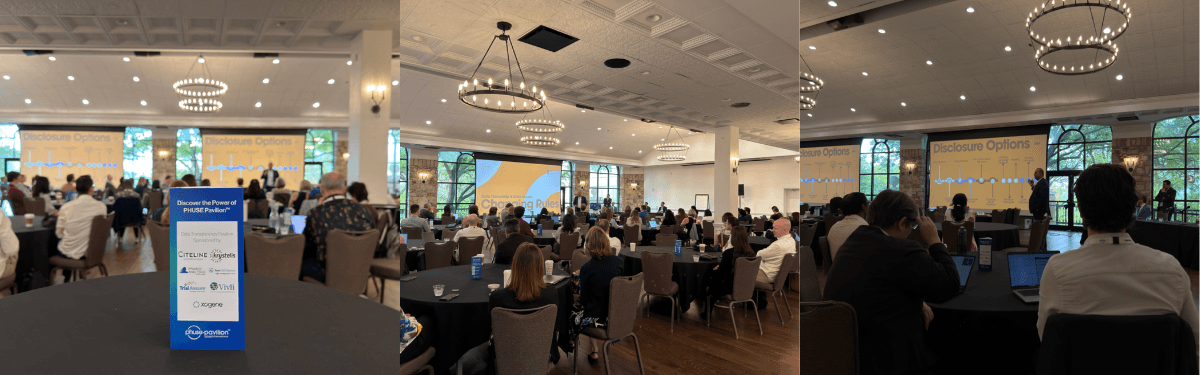
Frameworks and Readiness for Transparency
This session explored three critical dimensions of building sustainable transparency frameworks in clinical trial disclosure.
Ritama Gupta Dempsey (MSD) addressed the disclosure challenges posed by complex clinical trials – basket, umbrella and platform designs – presenting strategic submission approaches for ClinicalTrials.gov and EU CTIS that maintain patient-centred transparency while managing the intricacies of rolling-arm designs and independent sub-study registrations.
Lauren Haggerty (Bristol Myers Squibb) shared BMS’s experience integrating AI into plain language summary production, highlighting hybrid AI-human workflows, paediatric-friendly templates, continuous feedback loops, and a forward-looking vision for multimodal outputs – all while maintaining compliance and quality at scale.
Obaraboye Olude (Privacy Analytics) and Chantal Din-Bell (Sanofi) presented on transparency-by-design, outlining practical strategies for embedding transparency principles early in the product lifecycle, strengthening cross-functional collaboration, and building organisational frameworks for safe and efficient regulatory document disclosure.
Data Integrity and Public Trust
The Data Integrity and Public Trust session explored how public trust in clinical research is built through patient-centric design, transparent data sharing and credible accountability, including the ethical use of AI. In ‘Patient-Centricity in Practice: The Role of Data Integrity’, Sylvia Baedorf Kassis (MRCT) highlighted the critical role of data scientists, biostatisticians and clinical data managers in embedding patient centricity by involving patients in study design, leveraging real-world data, and applying health-literacy best practices such as plain language and effective data visualisation. These approaches improve understanding, support participant retention, and strengthen trust in research, with change driven at individual, team and organisational levels.
In ‘What Patients Are Interested in When It Comes to Data Sharing’, Deborah Collyar (PAIR) emphasised that patients value transparency, context and clarity on treatment options, outcomes and how their data is used. Patients want realistic expectations, reassurance that they are not alone, and clear answers to ‘What’s In It for Patients’ (WIIFP). The presentation reinforced the importance of diversity, equity, inclusion and accessibility, alongside ethical AI practices that prioritise transparency, human dignity and accountability.
The Panel Discussion – Including AI Ethics – brought these themes together, reinforcing that public trust is earned at the intersection of patient-centric design, clear communication about data and AI, and accountable governance. Panellists discussed practical ways to communicate data use and AI to non-experts and how aligning innovation with patient preferences enables trustworthy, patient-centred research that ultimately improves population health.

Data Protection and Anonymisation at Scale
This presentation series highlighted how clinical trial transparency is expanding from traditional tabular data to include imaging, wearable and genomic data, requiring scalable, risk-based anonymisation strategies (From Complexity to Consistency: Scalable Anonymisation Across Clinical Trial Portfolios – Ahmed Eldafrawy (Real Life Sciences) and Danielle DiBonaventura (Bayer)).
A unified framework is presented that combines quantitative risk assessment, standardised anonymisation controls and strong governance to enable consistent, compliant data sharing across portfolios (Scalable Anonymisation for Complex Clinical Trial Data: A Sponsor–Vendor Perspective – Abby McDonell (Privacy Analytics)).
Imaging data is shown to pose elevated privacy risk due to DICOM metadata, burned-in text and facial reconstruction, addressed through dual-layer anonymisation of metadata and pixels (Anonymisation of Imaging Data for External Research Platforms – Anush Revazyan and Mutiullah Qureshi (Biogen)).
Wearable and genomic data introduce additional challenges related to data volume, continuity, and limited transformability, requiring clear documentation, controlled access, and oversight. Applying a common anonymisation strategy across studies and data modalities reduces operational burden, minimises inconsistency and cumulative risk, and supports timely, trustworthy data disclosure while preserving scientific value.

Global Transparency Trends and Regional Insights
The Global Transparency Trends and Regional Insights session examined how transparency expectations, disclosure practices and patient-focused communication continue to evolve across regions, highlighting both progress and persistent gaps.
In ‘Measuring What Matters: Metrics and Trends from the Good Pharma Scorecard’, Jennifer Miller (Yale School of Medicine) shared insights from nearly two decades of work developing the Good Pharma Scorecard. Drawing on five scorecards covering transparency, data sharing, diversity and inclusion, access to medicines and patient centricity, she presented a mixed global picture. While transparency scores for large pharmaceutical companies initially improved, they declined for drugs approved between 2018 and 2021, with many assessed companies failing to meet FDAAA requirements. Improvements in reporting trial participant demographics were not matched by meaningful gains in the representation of older adults or racial and ethnic minorities in oncology trials. Miller also highlighted significant inequities in global access to medicines, with countries – particularly in Africa – that contributed to drug testing experiencing near-zero access within five years of FDA approval.
Regional complexity was further explored in ‘RegulASIAN Uncovered: Navigating Asia’s Clinical Trial Disclosure Landscape’, presented by Ben Evans (Citeline). Ben demonstrated that although Asia now accounts for more than half of global clinical trial initiations, disclosure requirements remain highly fragmented. Using Citeline’s TrialScope Intelligence data, he mapped wide variation across 21 jurisdictions in protocol registration timing, results-posting obligations, and enforcement mechanisms. Requirements range from early pre-ethics registration in some countries to delayed post-approval disclosure in others, with enforcement spanning fines, public naming of violators, licence suspension and criminal sanctions. Country-specific deep dives and an overview of ICH E6(R3) adoption timelines illustrated both regulatory momentum and ongoing operational complexity across the region.
The session concluded with ‘Industry Trends in EU CTIS Transparency Documentation’, featuring Sanjay Bagani (Xogene) and Kara Groom (Merck). Sanjay analysed thousands of CTIS submissions to assess industry performance under the EU Clinical Trials Regulation, showing positive trends such as increased adoption of plain language summaries, improving readability scores, and stronger structural compliance – while identifying academic sponsors as a continuing gap. Kara complemented these findings by outlining Merck’s internal processes for developing meaningful plain language summaries, highlighting the role of health-literacy medical writers, structured templates, standardised language, and patient advisory input. Together, the presentations reinforced that regulatory compliance alone does not ensure true transparency, and that effective communication requires sustained investment and intentional infrastructure.
Participant Empowerment and Responsible Data Sharing
The session on participant empowerment and responsible data sharing highlighted key gaps between intent and practice across the clinical research lifecycle. The trial discovery discussion showed that recruitment challenges are not just patient-driven – information barriers faced by physicians, such as unclear trial titles, inconsistent terminology and ambiguous eligibility criteria, significantly limit referrals, positioning disclosure teams as critical enablers of recruitment success. The participant data return panel raised fundamental questions about what returning results truly means and why, despite strong demand from participants, adoption remains inconsistent due to ethical, operational and regulatory complexities. The plain language summaries (PLSs) discussion highlighted that while PLSs are now expected, the industry continues to grapple with demonstrating their real value and integrating them effectively into broader communication strategies. Overall, the session emphasised that true patient centricity requires a system-level shift towards clearer, more consistent, and meaningful communication.
AI and Automation
The AI and Automation session attracted a full room with standing attendees throughout, underscoring strong interest and engagement in the topic.
The session opened with Vidhi Vashisht (Krystelis), who shared a detailed case study on implementing AI to support the authoring of plain language summaries. Drawing on a live project experience, Vidhi highlighted key learnings around governance, prompt design and multi‑agent models, demonstrating how AI can deliver significant efficiency gains while maintaining regulatory and quality expectations. Cathal Gallagher (Regeneron) followed with an energetic and highly interactive presentation, including a live demo that showed how AI and automation tools can dramatically reduce manual workload. By making automation tangible, practical and entertaining, Cathal’s session resonated strongly with the audience. Woo Song (Xogene) then provided an in‑depth and insightful overview of AI solutions for clinical data transparency, outlining when to apply AI technologies based on scope, modelling needs and cost considerations, and illustrating the value of blending tools appropriately. The session concluded with Zach Weingarden’s (TrialAssure) high‑level perspective on using chat‑based AI technologies to support the identification and safeguarding of confidential and commercially sensitive information.
Industry Perspectives on Anonymisation and Data Disclosure
The Industry Perspectives on Anonymisation and Data Disclosure session brought together four complementary presentations offering a clear view of how clinical data anonymisation is evolving across industry and regulatory settings. Together, the presentations explored how organisations are responding to increasing transparency expectations while ensuring patient privacy and protecting sensitive information.
A central theme was the need to balance privacy with the scientific value of shared data. Speakers highlighted that anonymisation decisions are becoming more thoughtful and measured, moving beyond purely rules-based approaches towards strategies that combine structured methods with expert judgement. Several presentations focused on the challenges of narrative clinical data, where detailed context is essential for interpretation but can introduce higher privacy risk if not managed carefully.
Insights from industry surveys and regulatory review experience showed growing alignment between sponsor practices and health authority expectations, particularly under EMA Policy 0070. The regulatory perspective reinforced the importance of clear justification, avoiding unnecessary redaction, and focusing on information that genuinely requires protection. Overall, the session reflected a maturing landscape in which anonymisation and data disclosure are increasingly treated as strategic, risk-aware processes, supported by open dialogue between industry and regulators.
Best Practices in Handling CCI
The Best Practices in Handling CCI session examined how organisations can protect commercially confidential information (CCI) in an increasingly transparent regulatory environment, emphasising the need for proactive, lifecycle-wide, enterprise-level approaches rather than reactive, document-by-document redaction. Kali Tarascavage (Otsuka) shared an experience-driven perspective on managing CCI across the full product lifecycle, highlighting the global shift towards a ‘releasable-by-default’ mindset and the importance of precise, well-justified redactions supported by early planning. Practical tools such as CCI lifecycle heat maps and dynamic CCI libraries were presented as essential for consistency, prioritisation and efficient regulatory response, alongside a forward-looking view of AI-enabled CCI management.
Sanjay Bagani (Xogene) presented the PHUSE white paper on protecting CCI under the EU Clinical Trials Regulation, outlining practical guidance on CCI identification, systematic redaction and lifecycle-based CCI libraries, and noting that the paper is now open for public comment.
In ‘Enhancing Protection of Confidential Commercial Information through Unified Cross-Functional Strategic Alignment’, Sarah Tursi and Nancy Williams (Johnson & Johnson) highlighted the challenges of managing CCI at scale and advocated for a unified model built on people, process, technology and governance, centred on a governed CCI library as a single source of truth.
The session concluded with ‘One Workflow To Rule Them All: Uniting Anonymisation and CI’, by Lee Berry (CSL Behring) and Nirpal Virdee (Real Life Sciences), which called for unified, governed workflows that integrate anonymisation and confidential information management to improve consistency, auditability and scalable disclosure.
Conclusion
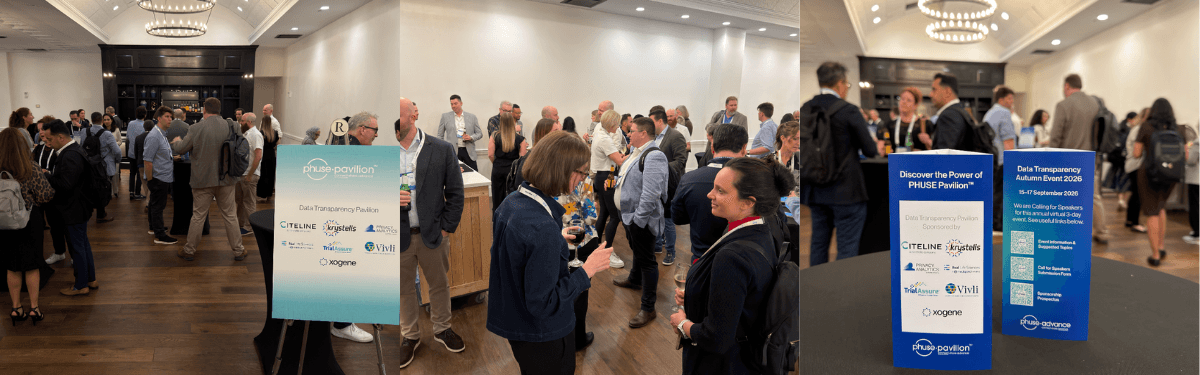
The discussions across the Data Transparency Pavilion demonstrated the breadth and maturity of current transparency practices, alongside the challenges still to be addressed as data, regulation and technology continue to evolve. All presentations from the Pavilion are available via the PHUSE Archive, providing an ongoing resource for those looking to explore the shared frameworks, case studies, and practical guidance discussed during the sessions. Together, these materials reinforce PHUSE’s commitment to supporting collaboration, best practice and trustworthy data sharing across the clinical research community.
Thank you to our speakers for sharing their expertise, insights and real‑world experiences, which were instrumental in shaping the high quality and relevance of the Pavilion discussions.
Thank you also to our sponsors. For more information on how to support PHUSE events, visit the PHUSE website.

Call for Papers is Open!


Call for Speakers for the Data Transparency Autumn Event and Real World Data Autumn Event closes on 8 May – submit your 150-word abstract before it’s too late.